As cities and communities wrestle with growing waste and public health concerns, the interplay between individual behaviours like fly-tipping and institutional responses like recycling policy becomes increasingly critical. What if we mapped this dynamic on a matrix to explore four plausible futures? Using The Future Matrix framework, we can create a strategic lens to imagine the implications—and opportunities—of our choices.
The Axes of Waste Management
On one axis, we track fly tipping frequency, a proxy for civic engagement, waste accessibility, and enforcement. On the other, we place local recycling policy strictness, capturing how open or restricted municipal services are in accepting various types of waste.
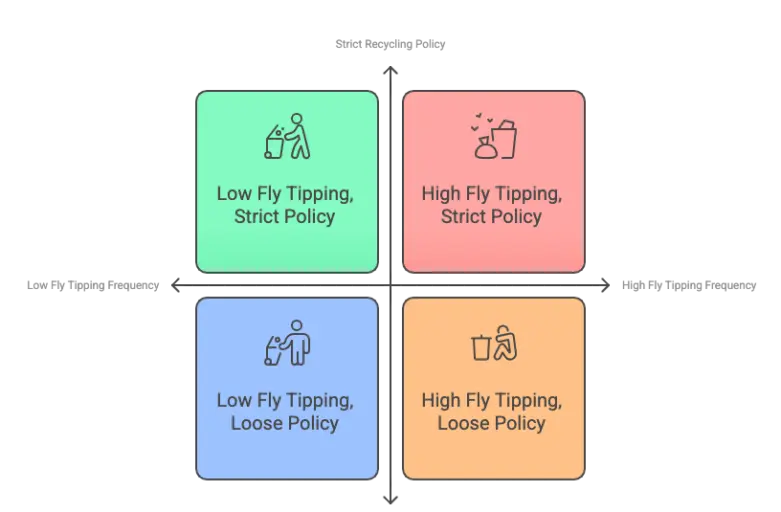
Let’s examine the four resulting quadrants:
Quadrant 1: Clean & Cooperative
(Low fly-tipping, Flexible recycling policy)
Name: “Eco Harmony”
In this optimistic scenario, communities experience minimal illegal dumping. Recycling centres are open, well-publicised, accept a broad range of materials, and are easily accessible by residents. Public trust is high, and there are community-led education and monitoring initiatives.
Implications:
Lower municipal clean-up costs
Strong community engagement
Positive environmental impact
Opportunities for innovation in circular economy ventures
Quadrant 2: Clean but Constrained
(Low fly-tipping, Strict recycling policy)
Name: “Disciplined Green”
Here, fly tipping is low, possibly due to effective enforcement and cultural norms, but recycling policies are rigid—limited operating hours, complex sorting rules, and tight restrictions on accepted materials.
Implications:
Residents comply but feel frustrated
Potential for black markets in waste removal
Missed opportunities to engage the public in broader sustainability efforts
Demand for private-sector waste solutions rises
Quadrant 3: Dumped & Dismissed
(High fly-tipping, Strict recycling policy)
Name: “Wasteland Bureaucracy”
A worst-case scenario where restrictive recycling policies push people toward illegal dumping. Fly tipping is rampant, straining local government resources and damaging public spaces and morale.
Implications:
Escalating environmental degradation
Erosion of trust in local authorities
Health risks increase
Policymakers under pressure to overhaul broken systems
Quadrant 4: Dumping for Convenience
(High fly-tipping, Flexible recycling policy)
Name: “Convenient Chaos”
Recycling centres are accommodating, but without strong cultural or legal deterrents, dumping continues. The flexibility backfires, encouraging a disposable mindset.
Implications:
Centres may be overwhelmed or abused
High maintenance costs
Inconsistent outcomes across neighbourhoods
Tensions between convenience and accountability
Where Are We Now—and Where Do We Want to Be?
The real power of this matrix is not prediction, but preparation. By identifying which quadrant a community currently inhabits, stakeholders can develop strategies to either maintain their position or shift toward a more desirable future.
For example, a community in “Convenient Chaos” might bolster citizen education and social norms to reduce fly-tipping, without needing to tighten recycling rules. Conversely, a city stuck in “Wasteland Bureaucracy” may need to relax policies and increase service accessibility to give residents viable alternatives.
Preparing for Possible Futures
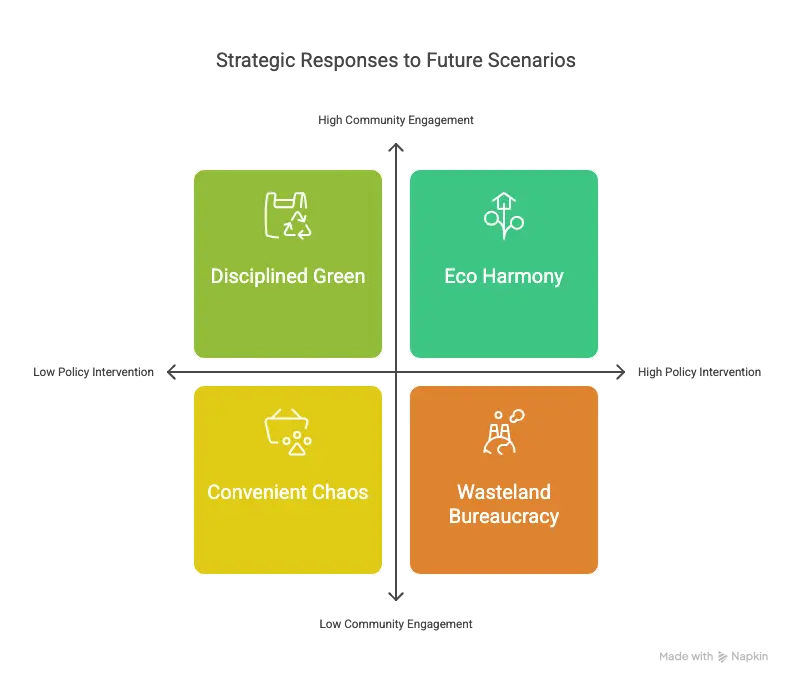
Each scenario calls for different systemic responses:
Eco Harmony: Invest in innovation and education; share success stories
Disciplined Green: Simplify systems; build trust; incentivise compliance
Wasteland Bureaucracy: Immediate policy reform; rapid-response clean-up units; community engagement
Convenient Chaos: Increase enforcement; deploy behavioural nudges; monitor facility usage
Conclusion: The Future is Sorted
The Future Matrix doesn’t forecast one inevitable outcome—it offers four. What makes it powerful is its simplicity and flexibility. By mapping fly tipping against policy restrictiveness, we can create not just awareness, but action plans tailored to each context.
Ultimately, waste isn’t just a physical problem—it’s a mirror of our values, our systems, and our foresight. The good news? With the right matrix, we can plan our way out of even the messiest of futures.